|
Having trouble reading this? View on the web
The following is a sponsored message. Health Union LLC does not endorse any specific product, service or treatment. |
|
Heidi is a volunteer with the SHARE Network, a Johnson & Johnson program made up of people who are dedicated to inspiring others through their personal health journeys and stories of caring. Heidi’s husband, Mike, was diagnosed with bladder cancer in 2023 at age 46. Both have been compensated by Johnson & Johnson for their time to develop this content. Heidi and Mike’s experiences are unique and not representative of all care partners and patients. |
|
As an elementary school teacher, wife and mother, planning is my way of bringing order to my family and my classroom. But when my husband, Mike, was diagnosed with bladder cancer in 2023 at just 46, all my planning couldn’t prepare me for the challenges ahead. Though it was a relief to finally have a diagnosis, the months before and after were filled with turbulence, anxiety, and a profound sense of helplessness.
The journey to diagnosis
Before Mike’s official diagnosis, I had already started doing my own research. I asked friends, family and colleagues what we should expect and tried to be prepared for any scenario. However, nothing truly readies you for the unknown, and the wait for a diagnosis kept me up night after night. |
|
|
From the time Mike first showed symptoms—pain and frequent urination1—to the final diagnosis, four months passed. That was four months of navigating the unknown as best I could. When we learned Mike had non-muscle invasive bladder cancer (NMIBC), we were in shock.
It is estimated more than 84,000 people will be diagnosed with bladder cancer in 2025.1 As a specific bladder cancer type, NMIBC represents about 75% of new bladder cancer cases.2
Mike was young, with no family history of bladder cancer, and he didn’t smoke. Most people who are diagnosed with bladder cancer are older than age 55 and smoking is the most well-established risk factor for bladder cancer, accounting for half of all cases in the U.S.1,3 Mike’s case felt like an anomaly. |
|
|
Navigating treatment
We learned that, surprisingly, the standard of care in certain kinds of bladder cancer hasn’t significantly changed in 40 years.4 Standard treatment options for NMIBC have traditionally consisted of Bacillus Calmette-Guérin (BCG) therapy (an immunotherapy) or chemotherapy inserted via catheter into the bladder, as well as radiation, or surgery like bladder resection or removal (radical cystectomy).1,2
Mike’s doctor prescribed BCG treatment, followed by bladder resection, also known as a transurethral resection of bladder tumor (TURBT).5 Overall, our experience has taught us to take one day at a time and not get too far ahead of ourselves. We had to painfully let go of planning. It was probably the biggest lesson we learned on this journey. |
|
Unfortunately, there’s more to BCG treatment than just signing up to get it. It requires a urologist, and the nearest one was about 45 minutes away. Getting the treatment took some persistence. When the cancer center scheduled Mike’s initial BCG treatment, I felt it should be sooner, so I called daily for weeks—and my efforts paid off because we eventually got an earlier appointment.
Every visit meant checking my emotions at the door and being Mike’s advocate, asking questions, and ensuring we understood his care plan. Cancer, including bladder cancer, is incredibly complex and it can be hard to navigate, especially given the challenging medical terminology.
Being an advocate and asking questions is one of the most important roles a care partner can play. It empowers you to actively participate in your loved one’s care, making you feel more informed and in control so you can advocate. |
|
My advice to other care partners: |
|

|
1. Use your time with clinicians wisely.
Our healthcare system can be overwhelming, and appointments are often jam-packed. I quickly learned to come prepared with questions written down in advance. When our doctor was delayed, it meant our appointment would be shorter, which is why I knew the importance of making the most of every interaction.
Life doesn’t stop with a cancer diagnosis, and we’re already on a tight schedule between work, managing our home and kids, and maintaining a rigorous treatment schedule. That’s why, ahead of every appointment, I wrote down everything I wanted to know, and if I didn’t understand something, I’d ask, "what does this mean?" Knowing the right questions to ask made me feel more confident and involved. |
|

|
2. Don’t be afraid to ask for help.
I’m not a nurse, so when Mike came home from surgery with a catheter, I was out of my comfort zone. I reached out to the mother of a former student who is a nurse, and she helped me learn wound and catheter care. Asking for help turned a stressful situation into a manageable one, reminding me that people want to help if given the opportunity. Even our teenage sons pitched in to help, taking turns with caregiving duties. |
|
|

|
3. Celebrate small victories.
Our journey has been filled with unexpected twists, but we learned to find light in small, positive moments. For instance, when Mike’s first BCG treatment was postponed, he was disappointed.
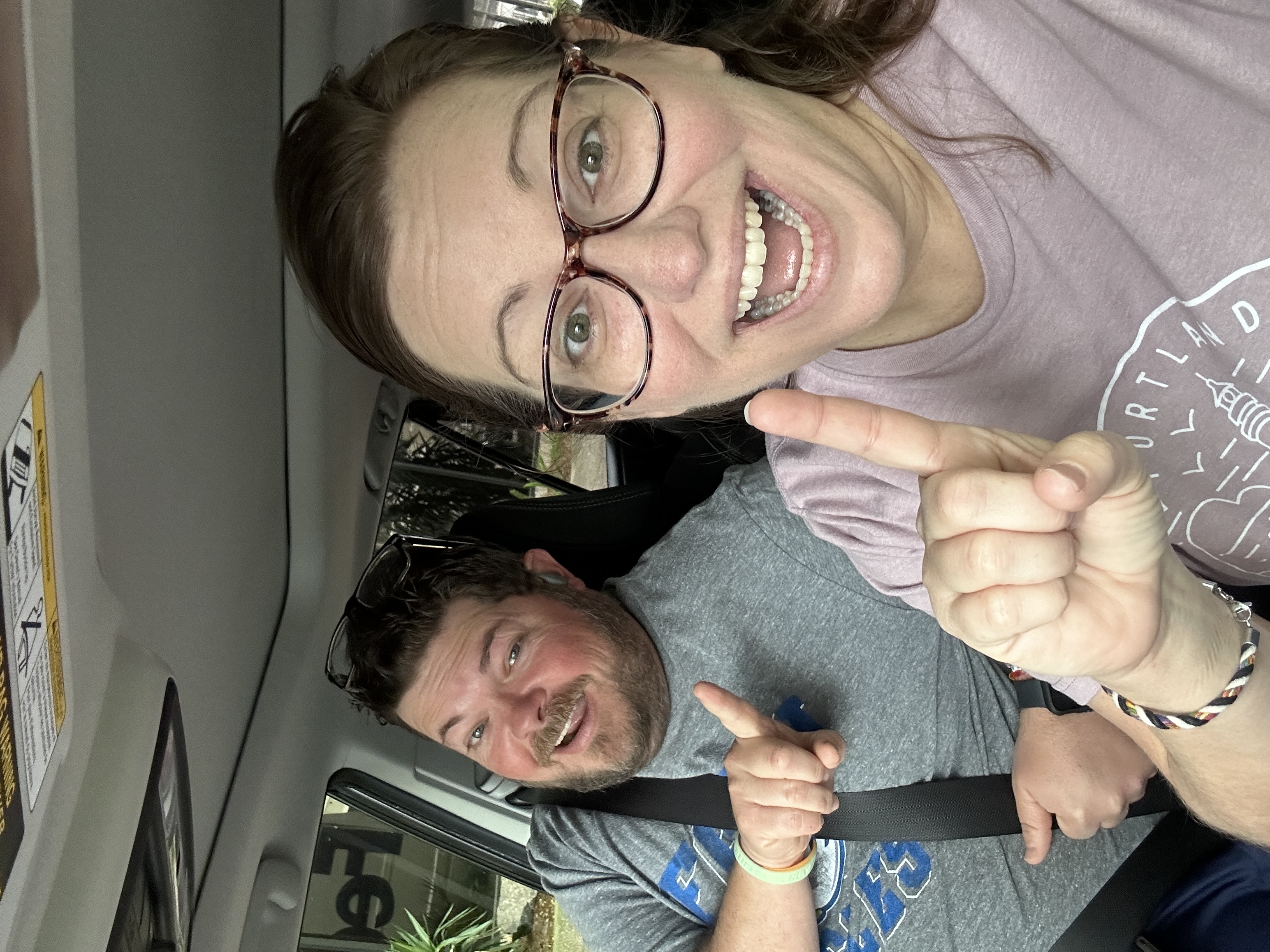
To lift his spirits, I asked friends and family to share their funniest photos with the caption "#1." The responses were overwhelming, and the support made us feel less alone. That day became a small victory, a reminder of the support that surrounds us, and a rallying moment for our community. |
|
Telling my story
As someone who teaches reading and writing, I believe in the power of a personal narrative. It allows us to reflect on life experiences and recognize the lessons learned along the way.
This year, I told my students our story. It was hard—some parts were too painful to revisit. I didn’t want to put my students through my pain and, to a certain degree, I’m not sure if I wanted to relive the past year when the future is still uncertain.
Wisely, my students told me, "Mrs. V., maybe this story isn’t right for right now." They taught me that some stories take time to tell. But now I’m ready. If you’re interested in joining me along my journey as a care partner, follow me on TikTok @heidivasallo. If you’d like to hear Mike’s perspective, you can follow him on TikTok @mistervee3.
Bladder cancer has disrupted our lives in ways we couldn’t imagine, but it also taught us resilience. Even when life doesn’t go as planned, we’ve found hope in small moments, the support of loved ones, and the comfort of knowing we’re not alone.
Our story isn’t over just yet, but there is a light at the end of the tunnel. |
|
2. |
Grabe-Heyne K, Henne C, Mariappan P, et al. Intermediate and high-risk non-muscle-invasive bladder cancer: an overview of epidemiology, burden, and unmet needs. Front Oncol. 2023;13:1170124. doi:10.3389/fonc.2023.1170124 |
|
|
4. |
Jiang S, Redelman-Sidi G. BCG in bladder cancer immunotherapy. Cancers (Basel). 2022;14(13):3073. doi:10.3390/cancers14133073 |
|
|
© Johnson & Johnson and its affiliates 2025 05/25 cp-489113v1 |
|
Please add sponsor@bladdercancer.net to your e-mail address to ensure our e-mails reach your inbox.
This e-mail was sent from BladderCancer.net, a property of Health Union, LLC, 1218 Chestnut Street, 3rd Floor, Philadelphia, PA 19107, United States.
This information is not designed to replace a physician's independent judgment about the appropriateness or risks of a procedure for a given patient. Always consult your doctor about your medical conditions. BladderCancer.net does not provide medical advice, diagnosis or treatment. Use of the site is conditional upon your acceptance of our terms of use.
Follow the link to opt out of future emails: Unsubscribe |
|
|
|